Ahmed Rashid Burrow is the new UNSA President
Ahmed Rashid Burrow, a 3rd year, Faculty of Law student is the new UNSA President. Chairperson of Team Ahmed Rashid Synergy won with 15 votes, while Team Favour, 12 votes and Team sawa with 6 votes.
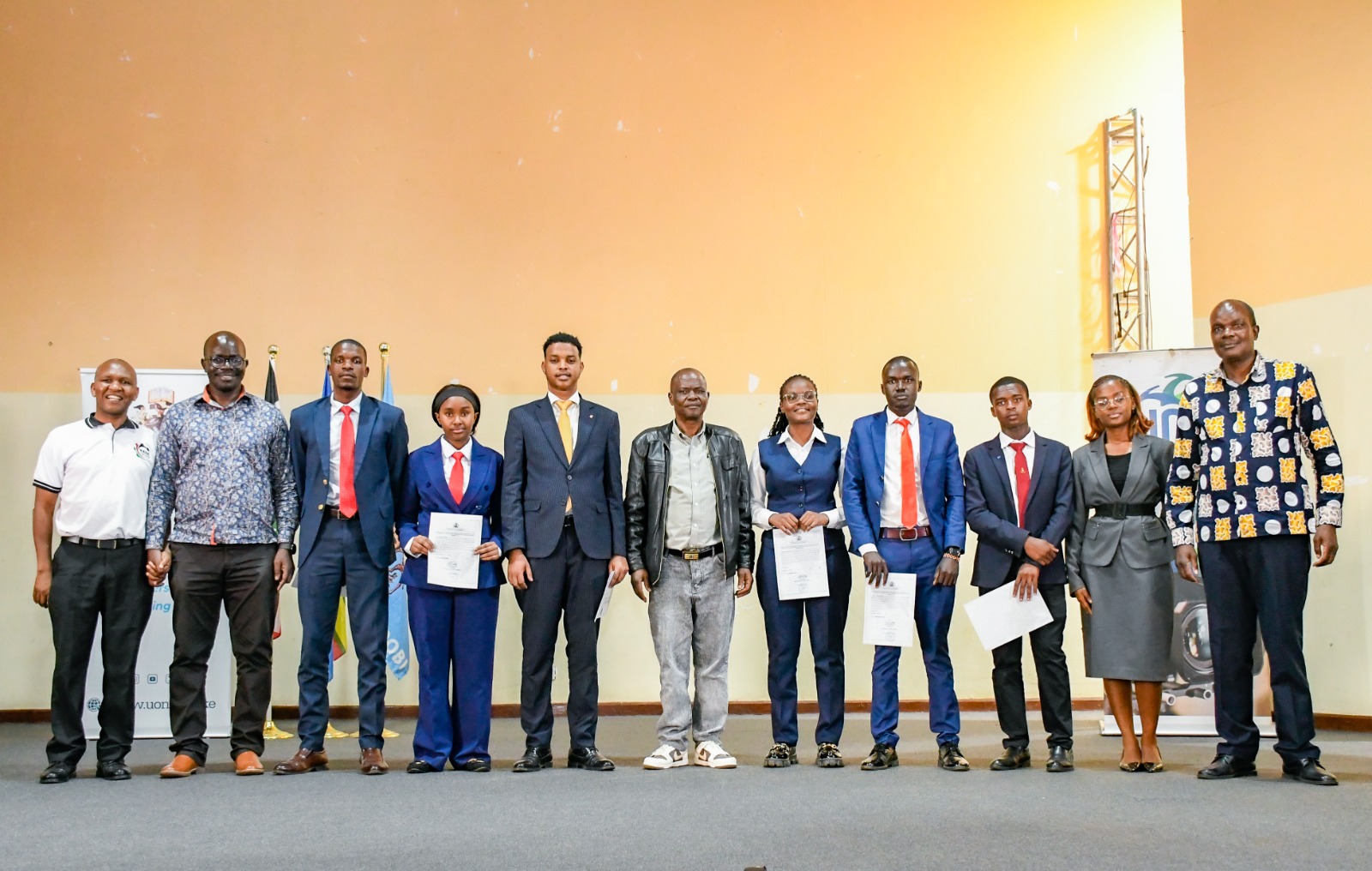
The winning team was composed of 7 students from different faculties and programmes as shown below;
Ahmed Rashid Burrow – Chairperson / UNSA President
Vivian Mukami Murithi – Vice-Chairperson
Ogola Tony Ochieng – Secretary General
Celine Wangui Wahome – Treasurer
Lomoe Epurite Gideon – Sports and Social Welfare Representative
Christopher Makau Kalamba – Persons with Disabilities (PWD) Representative
Marie-Anne Lwanzo Maunga – International Students Representative
While the Faculty and Campus Students Association elections were held on Friday, 22nd May, 2026 through the eballot. The winning teams from the different electoral colleges were:-
Faculty of Agriculture – Team Babello
Faculty of Arts and Social Science – Team Omoke Thunderss
Faculty of Built Environment and Design – Team Astrahh
Faculty of Business and Management Science – Team Mweresa
Faculty of Education – Team Renaissance
Faculty of Engineering – Team Bosire
Faculty of Health Sciences – Team Spensa
Faculty of Law – Team Pragmata
Faculty of Science and Technology – Team Marrion-Ms
Faculty of Veterinary Medicine – Tema Dira
Kenya Science Campus – Team Upeo
During the Swearing-in Ceremony held on Saturday, May 23, 2026, the University of Nairobi Management and the leadership gathered to witness the new student leadership being sworn in.
The Vice Chancellor, Prof. Ayub Gitau, congratulated the new student leaders, invited them for partnership in leadership and cautioned them against being negatively used and influenced in the nation’s politics. He noted, ‘As student leaders, you now carry the responsibility of representing the voices, ideas, concerns, and aspirations of your fellow students. Leadership must rise above personal interests, division, and short-term popularity. It must be anchored in service, integrity, accountability, and commitment to the collective good. I encourage you to embrace servant leadership; leadership that listens, unites, builds trust, and seeks solutions.’
‘These elections will remain significant in the history of our University. They were conducted during a period marked by legal processes, uncertainty, and intense interest from across the student community. Yet despite these challenges, the democratic process prevailed. That in itself is a powerful lesson on the resilience of institutions, the importance of the rule of law, and the strength of democratic engagement within our University community.’
The Chairperson of the UNSA Independent Electoral Commission, Prof. Collins Odote, described the 2026 elections as the climax of a process anchored in constitutional compliance and institutional accountability. He noted that the electoral process itself was shaped by multiple institutional and legal dynamics, including a two-month delay following conservatory orders issued by the High Court in response to election petitions, a development the Commission said reinforced the importance of judicial oversight in strengthening democratic systems within the University.
Prof. Odote also noted integrity concerns which defined parts of the process, with the Commission suspending elections in Mombasa and Kisumu campuses, which are set to undergo special elections at a later date. Despite these challenges, the elections were largely peaceful.
According to the Commission’s report, voter participation stood at 31.74%, with notable variation across faculties. The highest turnout was recorded in Kenya Science Campus (58.86%) and the Faculty of Built Environment and Design (51.12%), while the lowest participation was observed in the Faculty of Business and Management Science (19.31%) and the Faculty of Arts and Social Sciences (23.08%). Three faculties: Engineering, Health Sciences, and Law produced unopposed candidates.
Across the electoral landscape, representation also showed incremental progress. Ten out of eleven faculties and campuses had representation of students with disabilities, while nine recorded participation of international students.
In his inaugural address, UNSA President, Ahmed Rashid Burrow, described his election as the beginning of a new chapter anchored on collective responsibility and accountability. He expressed gratitude to students for their trust and participation in the democratic process.
He emphasized that leadership within his administration would not be individual-centred, but built on collective engagement, dialogue, and justice.
“Leadership is never about one person but the collective feature of everyone in the University,” he said, committing his administration to being accessible and guided by the shared goal of improving student welfare and the overall university experience.
As the ceremony concluded at Taifa Hall, the message that resonated across speeches and electoral reflections was one of continuity and responsibility: that student leadership at the University of Nairobi is not only a governance structure, but a training ground for service, accountability, and institutional transformation.
IEC Chairperson speech